Posts mit dem Label dán fríotha werden angezeigt. Alle Posts anzeigen

2025-05-14

An talamh naofa


The Holy Land, a 'found poem' in English with an Irish translation by 'finder' Gabriel Rosenstock.
Scots version: John McDonald.
From Mark Twain's travelogue The Innocents Abroad (1869)

The Holy Land


 . . .The relic that touched us most 
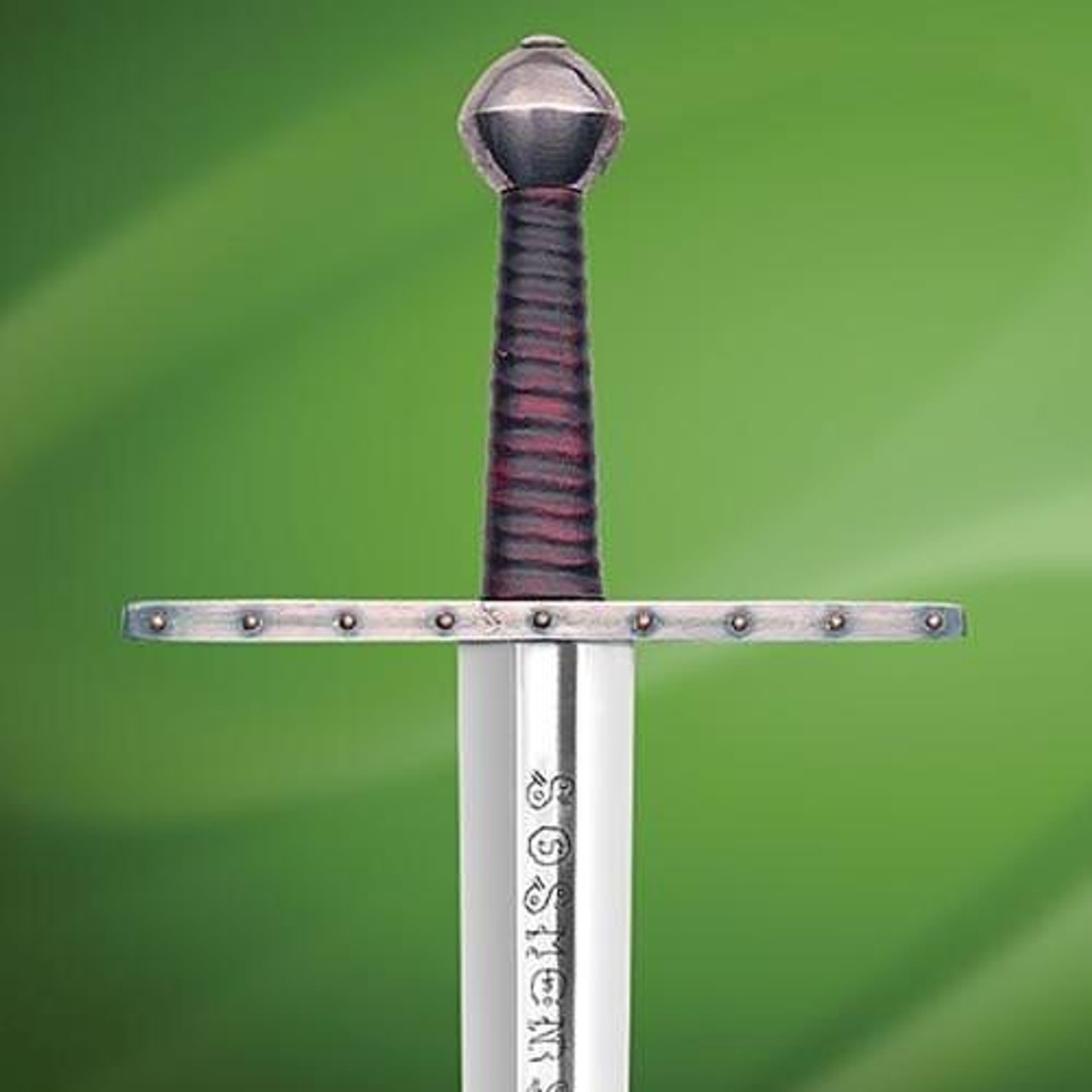
was the plain old sword of that stout Crusader, 
Godfrey of Bouillon — King Godfrey of Jerusalem. 

No blade in Christendom wields such enchantment as this — 
no blade of all that rust in the ancestral halls of Europe 
is able to invoke such visions of romance
in the brain of him who looks upon it — 
none that can prate of such chivalric deeds 
or tell such brave tales of the warrior days of old. 

It stirs within a man every memory of the Holy Wars 
that has been sleeping in his brain for years, 
and peoples his thoughts with mail-clad images, 
with marching armies, 
with battles and with sieges. 

It speaks to him of Baldwin, and Tancred, the princely Saladin, 
and great Richard of the Lion Heart.

It was with just such blades as these
that these splendid heroes of romance
used to segregate a man, so to speak, 
and leave the half of him to fall one way
and the other half the other. 

This very sword has cloven hundreds of Saracen Knights 
from crown to chin in those old times 
when Godfrey wielded it. 
It was enchanted, then, by a genius
that was under the command of King Solomon

When danger approached its master's tent 
it always struck the shield
and clanged out a fierce alarm upon the startled ear of night. 

In times of doubt, or in fog or darkness, 
if it were drawn from its sheath
 it would point instantly toward the foe, 
and thus reveal the way — 
and it would also attempt to start after them of its own accord. 

A Christian could not be so disguised that it would not know him 
and refuse to hurt him — 
nor a Moslem so disguised that it would not leap from its scabbard and take his life. 

These statements are all well authenticated 
in many legends that are among the most trustworthy legends 
the good old Catholic monks preserve. 

I can never forget old Godfrey's sword now . . 


An Talamh Naofa

 (dán fríotha in The Innocents Abroad le Mark Twain)

 . . . an t-iarsma is mó a chuaigh i bhfeidhm orainn
ná seanchlaíomh pléineáilte an chrosáidí théagartha úd,
Godfrey Bouillon–Rí Godfrey Iarúsailéim.
Níl claíomh sa Domhan Críostaí chomh draíochtúil leis–
claíomh meirgeach ar bith i hallaí móra na hEorpa

atá in ann aislingí rómánsacha a dhúiseacht
in inchinn an té a dhearcann air–
níl claíomh ar bith in ann gníomhartha gaisce a insint
mar é, ná scéalta laochais go léir ón seanré.

Tosaímid ag cuimhneamh ar na Cogaí Beannaithe
nár smaoiníomar orthu leis na cianta,
agus ár gcuid smaointe breactha le híomhánna
agus cathéide orthu, airm ag máirseáil,
cathanna agus léigir.
Meabhraíonn sé Baldwin dúinn, Tancred, Saladan prionsúil,
agus an rí mór Risteard Leonchroí.

Ba le claíomh mar é a dhein na sárlaochra
an duine a scaradh ó féin, mar a déarfá,
a leath dhe ag titim ar dheis
agus an leath eile ar chlé.

Scoilt an claíomh ceannann céanna seo
agus Godfrey á bhagairt.
na céadta Ridirí Saraistíneacha
ó bhaithis go smig sna seanlaethanta.
Bhí ginid ghlinne sa chlaíomh an uair úd
agus an Rí Solamh i gceannas air:

má tháinig namhaid gar do phuball a mháistir
bhuaileadh an claíomh an sciath –
torann a dhúiseodh na mairbh.
In aimsir an amhrais, má bhí ceo ann nó scamaill dhorcha,

níor ghá ach é a tharraingt ón truaill
agus dhíreodh sé laithreach bonn ar an namhaid,
agus bheadh gach aon ní soiléir ansin–
agus thabharfadh sé faoin namhaid a leanúint as a stuaim féin.

Ní fhéadfadh Críostaí a bheith chomh mór sin faoi bhréagriocht
nach n-aithneodh an claíomh é, gan é a ghortú –
ná Moslamach faoi bhréagriocht nach léimfeadh sé
as an truaill agus deireadh a chur leis.

Tá na ráitis seo go léir fíordheimhnithe
in an-chuid finscéalta, na finscéalta is iontaofa
a chaomhnaigh na seanmhanaigh Chaitliceacha.

Ní dhearúdfaidh mé seanchlaíomh Godfrey go deo . . .


THE HALY LAN

...the relic that muived us maist
wis the ordnar sword o yon stoot crusader,
Godfrey o Bouillon - keeng o Jerusalem.
Nae bled in Chrisendie hauds sic glamourie -
Nae bled that hings rousty in Europe's faimilie ha's
Kin cry furth sic veesions o romance
i the harnpan o yin whae goves on't -
Nane whae kin threep o sic chivalric acks
or threep sic campie clash o the kempies o langsyne.
 It mynds a chiel o the Haly weirs
Myndins doverin in's harnpan sin langsyne,
an fous's thochts wi mail-hapt eemages,
wi mairchin airmies,
wi stoors'n sieges.
It threeps tae'm o Baldwin. an Tankred, the princely Saladin,
an the muckle Richard of The Lion Heart.
It wis wi sic bleds as thir yins
thit thae braw heroes o romance
yaised tae sinder a chiel
Leain hauf o him tae faw yin wey
a hauf tae faw the tither
This verra sword hus cloven hunners o Saracen Knights
Frae croon tae chaft in aulden tymes
whan Godfrey waged it.
It wis forespoken, then, bi a genius
Whae wis unner the bidden o Keeng Soloman
Whan the uncannie oncomes the maister's tent
it ayewis struck the shiel 
an dirlt oot a fell alarm on the lugs o nicht.
In tymes o doot, or haar or derkness,
If drawn frae'ts sheath
It wid pynt tae the foe richt awa,
An sae show the wey -
It wid take aff efter thaim on'ts ain acoont.
A Christian nae maitter whit guise yaised it kent
an sae wid nivver herm -
Nor the Moslem Nae maitter hou guised it wid lowp frae'ts scabbert an tak's life.
Thae threepins'r weel qualifeed
In monie legends, maist amang the maist suithfast
the guid auld Catholic monks preserve.

Ah kin nivver foryet auld Godfrey's sword nou...


2025-05-09

Dán Fríotha / Found Poem

Old Delhi 

 
. . .in the middle of the Second World War,
I was walking down the Silver Market of Old Delhi 
when I heard the sound of firing. 

Making my way towards it, 
I turned a corner
and came upon a small crowd
defying an even smaller band of English soldiers. 

An elderly man of the poorest class, 
dressed only in a loin cloth, 
broke away from the crowd
and ran towards the soldiers. 

One of these pointed an automatic weapon towards him, 
but the man did not stop. 
He was shouting 
in a confused and hysterical manner 
and it seemed to me 
that he was not in possession of his senses; 

no doubt, as so often happens with Indians, 
the excitement and the previous shooting
had loosened his grip upon his nerves. He ran on, 
full tilt towards the soldiers. 

The Englishman with the automatic weapon 
pressed the trigger
and the Indian fell prone, 
jerking his legs
in a fashion that was almost ludicrous
and drumming with his fists on the ground. 

In a few moments he lay still, dead, 
with blood spouting 
from a series of wounds on his body.

I noticed that the small of his back 
(for he died on his face) 
was torn in several places
from the bullets which had passed through.

The crowd dispersed. 
They had been demanding that the English leave India. 

The man lay in the roadway 
in his blood, 
until a street-cleaning cart, 
requisitioned for the purpose, 
bore him away.


Found by GR in:

AULD DELHI

...I the mids o the saicont warl weir,
ah wis daunerin throuch the siller mercat o auld Delhi
whan ah heard the brattle o gunfire.

Airtin taewarts it,
roondin a cunyie
a cam on a thrang o fowk
defeein a pickle bourach o suddron sodgers.

A bodach o the puirtith cless,
cleedit anely in a loin claith,
brak frae the crood 
heidin fir the sodgers.

Yin sodger pyntit a gun it him,
bit he didnae stop.
He wis skirlin
he wis aw throuither
fegs ah thoucht
he micht be gyte;

nae doot, as aften kythes wi Indians,
the tirrivee o the umquhile brattle
hud lowst a grup o's mynd. He stooried on.
Straucht fir the sodgers.

The Englishman wi the gun
chirtit the tricker
an the Indian cowpt ower, liggit agroof,
yerkin's legs
gye pawkie lik
an thrummin the yirth wae's nieves.

Or lang he liggit deid,
wi bluid spootin
frae the monie sairs on's bouk.

Ah glisked the sma o's back
(fir he deed on 's neb)
wis riven whaur the monie bullets hud brust throuch.

The crood skailt.
They'd been protestin thit England win awa frae India.
The chiel liggit in the causey
in's bluid
till a scaffie's cairt
brocht in aince errand
cairriet him awa.

(Leagan Béarla na hAlban: John McDonald)

2025-03-02

DÁN FRÍOTHA / Walt Whitman (Found Poem in Collected Prose)

 THE WHITE HOUSE
Walt Whitman
le Thomas Wilmer Dewing
 

(A found poem, extracted from the prose by Walt Whitman)


I wander about a good deal,
sometimes at night under the moon.
Tonight took a long look at the President's house.
The white portico —
the palace-like, tall, round columns,
spotless as snow
 — the walls also —
the tender and soft moonlight,
flooding the pale marble,
and making peculiar faint languishing shades,
not shadows —
everywhere a soft transparent hazy,
thin, blue moon-lace, hanging in the air —
the brilliant and extra-plentiful clusters of gas,
on and around the facade, columns, portico,
 — everything so white, so marbly pure
 and dazzling, yet soft
 — the White House of future poems,
and of dreams and dramas,
there in the soft and copious moon —
the gorgeous front,
in the trees, under the lustrous flooding moon,
full of reality, full of Illusion —
the forms of the trees, leafless, silent,
in trunk and myriad angles of branches,
under the stars and sky —
the White House of the land,
and of beauty and night —
sentries at the gates, and by the portico,
silent, pacing there in blue overcoats —
stopping you not at all,
out eyeing you with sharp eyes,
whichever way you move.

2021-11-02

Réalachas

Ní ceart smaoineamh ar leith
nó sraith de smaointe
a chaitheamh i dtraipisí
díreach ar an gcúis
nach bhfónann siad 
don chine daonna.
Má tá smaoineamh ann
caithfear na geataí a oscailt dó.
Mar, má dhúnann tú na geataí
brúfaidh an smaoineamh isteach
nó ar nós na cuileoige san fhabhalscéal
sciorrfaidh sé isteach
gan fhios don saol.
An réalachas sa litríocht
cuir i gcás.
Nuair a nocht sé ar dtús
bhí goimh ar an saol
is a mháthair.
Cén fáth ar gá dúinn
eolas a chur ar an salachar go léir?
Le fírinne, ní gá.
Ach, ó shleamhnaigh sé isteach
bhí bréag ullamh aige:
chuir sé é féin i gcomparáid
leis an bpaiteolaíocht,
mhaígh go raibh sé úsáideach,
fóinteach agus, dá réir sin,
tugadh áit dó.
Is léir do chách anois
nach fóinteach atá an réalachas
ach dochrach,
an-dochrach . . .
Is deacair an bonn a bhaint de, áfach.

Dán is ea Réalachas a cuireadh le chéile as sliocht próis a fuarthas i leabhar de chuid Leo Shestov (1866 – 1938).

2021-10-27

Cois Claí


Deir an duine sách
Atá ar a shuaimhneas,
Deir sé leis féin:
‘Conas a mhairfeá
Mura mbeifeá cinnte
Faoin lá amárach?
Conas a chodlófá
Gan díon os do chionn?’
Ar mhí-ámharaí an tsaoil
Caitear amach ar thaobh an bhóthair é.
Beidh air an oíche a chur de
Cois claí.
Níl scíth i ndán dó.
Scanraithe ina bheatha atá sé.
D’fhéadfadh ainmhithe allta a bheith thart
Nó bacaigh cosúil leis féin.
Téann sé i dtaithí air
I ndeireadh na dála, áfach.
Téann sé sa seans,
Codlaíonn sé ar nós bacaigh
Cois claí.

Dán is ea Cois Claí a cuireadh le chéile as sliocht próis a fuarthas i leabhar de chuid Leo Shestov (1866 – 1938).